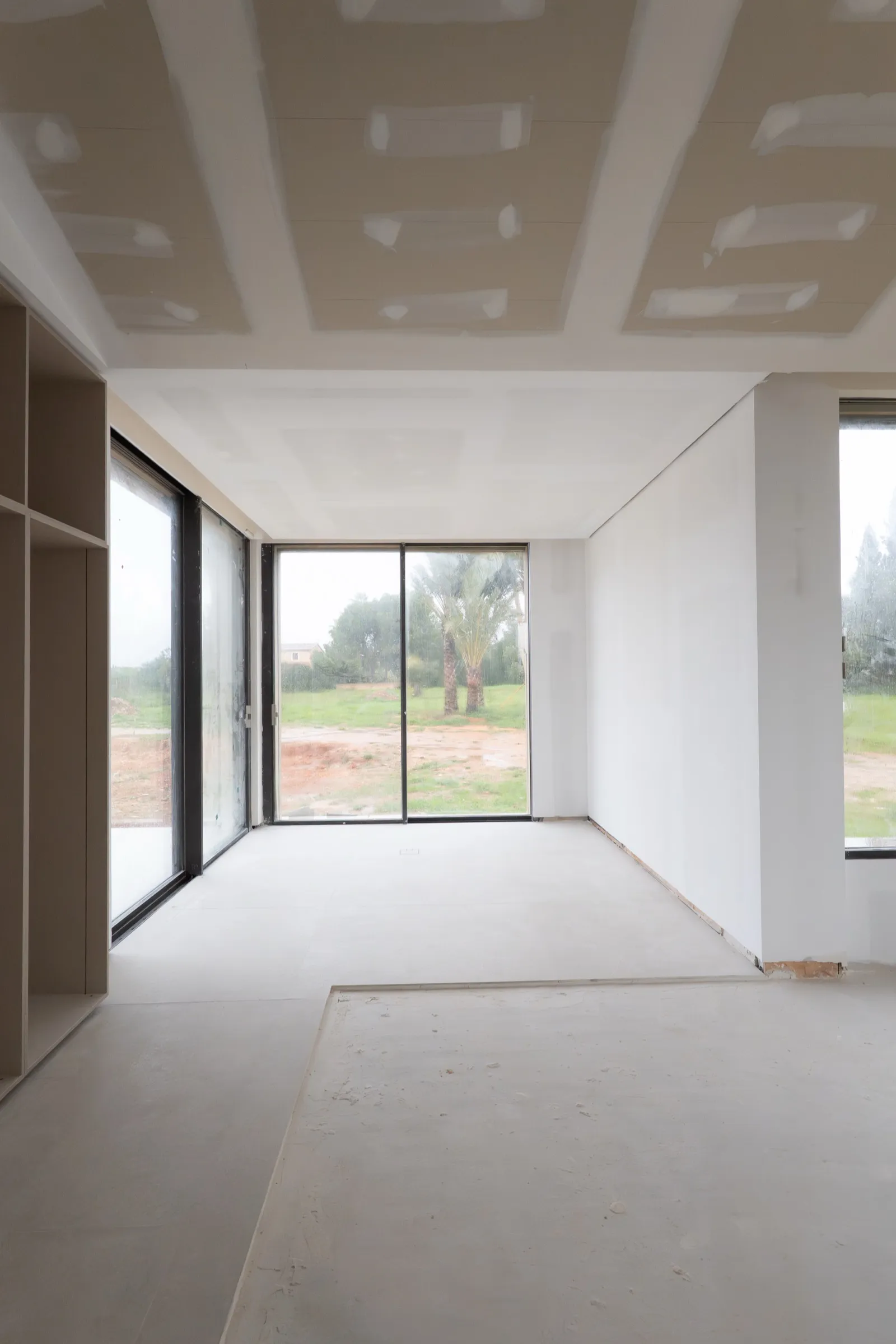
A wall lining — trasdosado in Spanish — is a plasterboard cladding fitted on the inside of a wall to flatten it, insulate it or hide services. There are three types — direct, semi-direct and self-supporting — and they cost from €27/m² for direct and from €29.50/m² for semi-direct and one-board self-supporting linings, according to Pladur Mallorca's November 2026 rates.
This guide explains what it is for, how to choose the type, how much space each one takes and what the installation steps are. If you are looking for someone to install it, the service is at drywall wall linings in Mallorca.
What a wall lining is and what it is not
Lining a wall means doubling it on its inner face. What sets it apart from a partition is its job: a partition separates two rooms and has two visible faces; a lining sits against a wall that already exists — a facade, a party wall, a masonry partition — and has only one.
That is why linings are used far more in refurbishment than in layout work. They do not change the floor plan of the home: they change how the wall behaves.
What a wall lining is for
- Flattening a wall. Out-of-plumb walls, old plaster or cracks are left ready to paint with no hacking off or re-plastering.
- Insulating against heat and cold. With insulation in the cavity, the U-value of an uninsulated wall drops from 1.60 to 0.38 W/m²K, the figure CTE DB-HE asks for in climate zone B3, and heating and cooling consumption falls by 20-35%.
- Insulating against noise. A 7-9 cm hollow-brick party wall insulates 33-38 dB and CTE DB-HR requires 50 dB between dwellings. A decoupled lining adds the missing 12-17 dB.
- Routing services. Cables, pipes and ducts run through the cavity, with no chasing of the wall.
Types of wall lining
| Type | How the board is fixed | Space lost | Takes insulation | Price |
|---|---|---|---|---|
| Direct | Bonded to the wall with bonding compound | 3-5 cm | No | From €27/m² |
| Semi-direct on omega channels | Screwed to omega furring channels fixed to the wall | 4-6 cm | No | From €29.50/m² |
| Self-supporting, one board | On tracks and studs independent of the wall | 6-8 cm | Yes, as an add-on | From €29.50/m² |
| Self-supporting, two boards | Double board on the same frame | 7-10 cm | Yes, as an add-on | From €34/m² |
November 2026 rates, VAT not included. A special board (moisture-resistant, fire-rated or acoustic) adds €3/m² on any type.
Direct wall lining
The board is bonded to the wall with dabs of bonding compound, with no framing. It is the fastest and takes the least space, but it needs a dry, firm substrate that is reasonably plumb. It leaves no cavity for services and, because it stays coupled to the wall, barely improves acoustics: 6 to 9 dB.
Semi-direct wall lining
The board is screwed to metal furring channels fixed to the wall. The channels correct the plane of an uneven wall and leave a minimal cavity, enough for cabling. It is the middle option when the wall is not flat enough to bond the board and there is no room for a full frame.
Self-supporting wall lining
The board is mounted on its own frame of galvanised steel tracks and studs, fixed to floor and ceiling and separated from the wall. That independence makes it possible to absorb out-of-plumb walls, leave a stone or damp wall untouched and, above all, fill the cavity with insulation. It is the only type that truly solves a thermal or acoustic problem.
Which insulation goes inside
- Mineral wool (glass wool or rock wool), 45 to 60 mm with a conductivity of 0.034 to 0.037 W/m·K according to the manufacturer's datasheet. It insulates against heat and also improves acoustics, so it is the usual choice.
- EPS (expanded polystyrene), 40 to 60 mm with a conductivity of 0.031 to 0.038 W/m·K. It is the most economical option when the goal is thermal only.
- XPS (extruded polystyrene), preferable on ground floors or damp walls because of its water resistance.
Whatever the insulation, the board changes with the room: standard in dry areas and moisture-resistant in bathrooms and kitchens, where a standard board absorbs more than 30% of its weight in water and moisture-resistant H1 board less than 5% (UNE-EN 520).
How much space is lost
It is the question that weighs most in small flats. A self-supporting lining with 48 mm studs, 40 mm of insulation and one 13 mm board takes 61 mm; with 70 mm studs, 70 mm wool and double board, 96 mm. In an 80 m² flat, insulating the facades means losing between 1.2 and 2.0 m² of usable floor area.
When every centimetre counts, direct lining stays at 3-5 cm, at the price of giving up the cavity and almost all the acoustic gain.
Wall lining price per m²
With Pladur Mallorca's November 2026 rates (materials and labour, VAT not included):
- Direct wall lining: from €27/m².
- Semi-direct lining on omega channels: from €29.50/m².
- Self-supporting lining, one board: from €29.50/m², with framing, BA13 board and joint treatment.
- Self-supporting lining, two boards: from €34/m².
- Special board (moisture-resistant, fire-rated or acoustic): +€3/m² on any type.
- Cavity insulation, self-supporting only: +€6/m² acoustic and +€7/m² thermal.
As a reference, lining a 10 m² wall with the one-board self-supporting system costs from €295, and from €365 with thermal insulation. What moves the price from there is the stud depth, the board type, the insulation and site access.
How a self-supporting lining is installed
- Wall diagnosis. We check for damp, how far out of plumb it is and which services run through it.
- Setting out. The line of the new wall is marked by laser on floor and ceiling.
- Frame. Tracks top and bottom, with resilient band underneath, and vertical studs slotted between them.
- Services and insulation. Cables and pipes first; then insulation between the studs, with no gaps.
- Boards. Screwed every 25 cm, with staggered joints if the board is double.
- Joints. Tape and compound in three coats, sanding and 24-48 hours of drying before painting.
A two-installer crew fits 20 to 30 m² a day. A 20 m² room is ready in 1-2 days and an 80 m² flat in 3-5.
Mistakes worth avoiding
- Bonding a direct lining onto a damp wall. Bonding compound needs a dry substrate; with damp, the right system is self-supporting, which does not touch the wall.
- Screwing the frame to the wall when the goal is acoustic. Every rigid fixing transmits the vibration you wanted to cut.
- Using standard board in a bathroom. It bows with the steam; moisture-resistant board goes there.
- Leaving the cavity empty. Without insulation, the lining flattens the wall but does not insulate it.
A case in Mallorca: marés stone house in Alcúdia
In an 18th-century house inside Alcúdia's walled precinct, with 50 cm marés stone walls and no insulation at all, linings with 15 mm board and 40 mm XPS were fitted on the 48 m² of external walls. Calculated heat loss fell by 65% and, in the first winter after the renovation, heating consumption was 40% lower than the technician's prior estimate. The whole job, including a false ceiling and a new layout, was completed in 11 working days. The case is published on the drywall in Alcúdia page.
Wall lining or external insulation
A lining is not the only way to insulate a wall. External insulation (SATE) does it from outside, removes thermal bridges and cuts consumption by 35-50%, against 20-35% for a lining. But it needs scaffolding, a licence and the community's agreement, and it is not possible on protected facades. The full comparison is in SATE vs drywall wall lining.
If you already know a lining is what you need, drywall wall linings in Mallorca covers the types we install and how to book the free site visit.