SATE costs €60-90/m² in Mallorca in 2026 and cuts energy consumption 35-50%. Interior drywall wall lining costs €35-48/m² and cuts consumption 20-35%. The price gap — and the final call — depends on four variables: property type (villa vs flat), façade protection, control over the envelope (single-family vs community) and project urgency.
SATE (External Thermal Insulation System, ETICS under UNE-EN 13499) and interior drywall wall lining are the two dominant solutions to meet CTE DB-HE §3 "Limitation of energy demand" in renovations (Mallorca = climate zone B3, Annex B). This guide compares them with real Mallorca 2026 data and two executed cases — part of the 6,000+ projects Plaquistas y Acabados SL has delivered since 2004.
What SATE Is and How It Works
SATE stands for External Thermal Insulation System, known as ETICS under European standards UNE-EN 13499/13500. It consists of fixing insulating panels (EPS, XPS or mineral wool) onto the external façade, covering them with mortar reinforced with glass-fibre mesh and finishing with a mineral, acrylic or silicone render.
SATE components
The system is built in layers:
- Adhesive + mechanical fixing of insulating panels onto the existing façade.
- Base mortar coat with embedded glass-fibre reinforcement mesh (mechanical strength).
- Levelling primer.
- Decorative finish: mineral, acrylic or silicone render in varied colours and textures.
SATE benefits
The key technical benefit of SATE is that it wraps the building like a continuous blanket, eliminating thermal bridges (columns, slab edges, window frames, façade-roof junctions) that account for 20-35% of total thermal losses in uninsulated buildings. Interior wall lining cannot resolve these bridges because it works only from inside.
SATE also protects the existing façade from weather (rain, wind, solar radiation), extending envelope life. And being placed outside, it does not reduce interior floor area.
SATE drawbacks
SATE requires working on the façade, with scaffolding (public-space occupation licence), a major-works licence or prior notice with technical project, and in multi-family buildings, community agreement by qualified majority. It is not viable on buildings with listed façades.
In Mallorca, this last point is decisive: thousands of homes in Palma — old town, La Lonja, Santa Catalina, Eixample and El Jonquet — are in buildings with protected façades that cannot be altered externally.
What Interior Wall Lining Is and How It Works
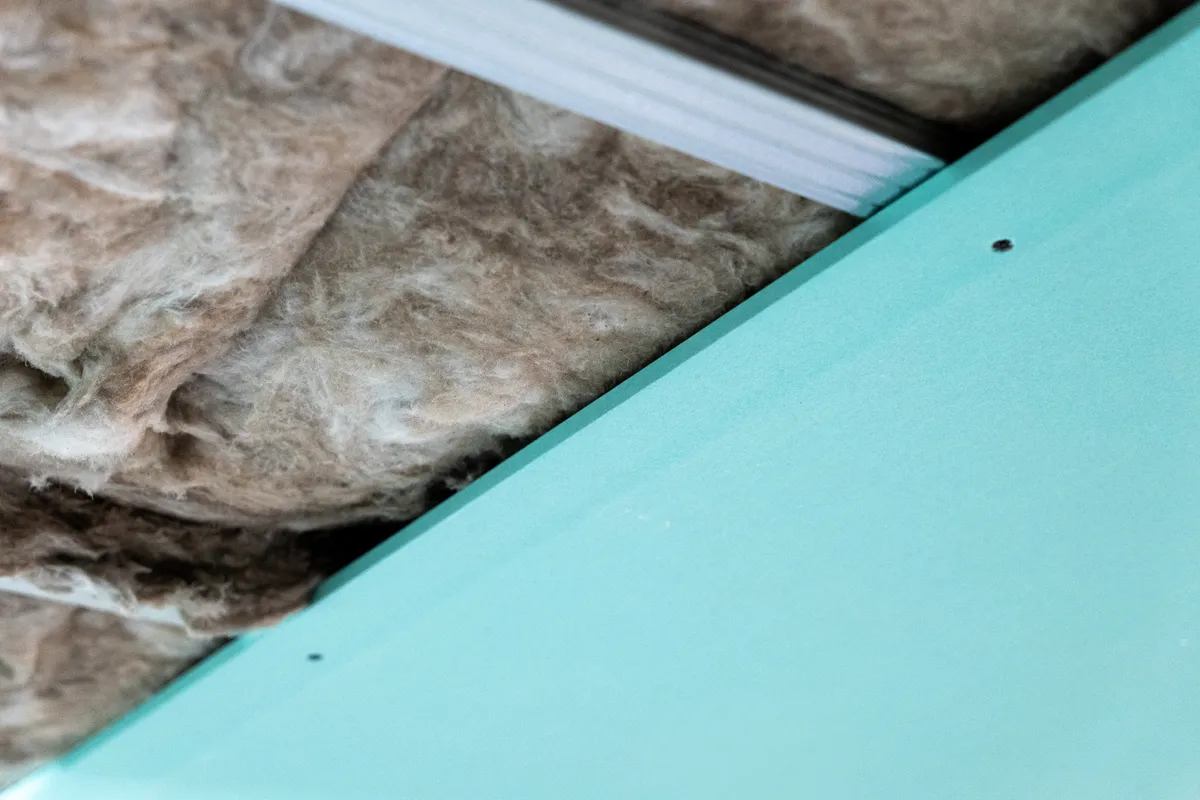
An interior wall lining consists of fitting a second leaf of drywall (plasterboard UNE-EN 520) on the inside face of the existing façade, with the cavity filled with insulation and a self-supporting metal frame, without touching the original façade.
Interior wall lining components
- Self-supporting metal frame (channels + studs of 48-70 mm UNE-EN 14195), set a few millimetres off the existing wall to avoid direct vibration transmission.
- Cavity insulation: Isover/Rockwool mineral wool, graphite EPS or spray polyurethane.
- 12.5 or 15 mm plasterboard, in one or two layers, ready to paint.
Interior wall lining benefits
- No special façade permits or scaffolding required.
- Delivered flat by flat without depending on the community.
- 4-7 day timescale in an 80 m² flat (vs 15-25 days for SATE on a villa).
- Per-m² price considerably lower (€35-48/m² vs €60-90/m²).
- Can improve acoustic insulation at the same time using high-density mineral wool.
- Delivers a smooth new interior surface, ready to paint or finish.
Interior wall lining drawbacks
- Reduces usable area 5-8 cm per lined wall.
- Does not eliminate structural thermal bridges (columns, slab edges).
- Demands careful execution with vapour barrier at window jambs, corners and service penetrations to avoid interstitial condensation.
See how we execute a drywall wall lining in the drywall installation in Mallorca guide.
Price Comparison: SATE vs Wall Lining in Mallorca (2026)
Prices in the Mallorca market in 2026. VAT at 10% not included.
SATE (with scaffolding, material, labour and render, excluding permits):
- 60 mm EPS: €60-75/m².
- 80 mm EPS: €68-82/m².
- 60 mm mineral wool: €75-90/m².
Interior drywall wall lining (frame, insulation, board, joints and primer):
- 40 mm mineral wool: €35-42/m² (full installed system; material from €7/m² in our price table).
- 40 mm graphite EPS: €38-45/m².
- 60 mm mineral wool or spray polyurethane: €42-48/m².
Real context: insulating the façade of a villa with 150 m² of façade area with SATE in 80 mm EPS costs €10,200-12,300. Wall-lining the same area on the inside with drywall and 60 mm mineral wool costs €6,300-7,200. Investment difference: €3,000-5,000.
However, SATE — by eliminating thermal bridges — cuts energy consumption 35-50%, against 20-35% for wall lining. Long term, that higher efficiency can offset the cost gap. See how to improve the energy certificate in Palma to understand the rating impact.
For a tailored estimate, see thermal insulation in Mallorca.
Decision Matrix: When to Pick Each System
The choice depends on factors beyond price. Summary by property type in Mallorca:
- Single-family villa without façade restrictions: SATE. Full envelope control, thermal-bridge removal, better long-term result.
- Flat in multi-family building with community agreement: SATE if the façade allows it and there is qualified agreement. Otherwise, wall lining.
- Flat in a building with protected or listed façade: interior wall lining. No alternative.
- Home in Palma's old town: interior wall lining. Heritage restrictions prevent SATE in virtually every case.
- Holiday apartment with fast renovation: interior wall lining. Speed is decisive and does not depend on third parties.
- Building in comprehensive rehabilitation: SATE. Wraps the full façade and removes thermal bridges globally.
- Home with façade moisture problems: SATE. Protects the façade from outside and prevents interstitial condensation. Wall lining can worsen the problem without vapour barrier.
- Tight budget with need for immediate result: interior wall lining. Lower investment, shorter timescale, noticeable result from day one.
- Home with tight interior area: SATE if viable (does not take interior space). If not, weigh the loss of 5-8 cm from wall lining.
The Mallorca Factor: Why Wall Lining Wins in Many Cases
Mallorca has specifics that tilt the balance towards interior wall lining in a high percentage of projects. It is not that SATE is a worse system — local conditions simply limit its application.
Protected heritage in Palma
Palma City Council's heritage-protection catalogue includes thousands of buildings in the old town, La Lonja, Santa Catalina, the Eixample and El Jonquet. These façades cannot be altered, and any external intervention requires a favourable heritage report that is rarely granted for SATE. In these buildings, interior wall lining is the only route.
Multi-family buildings and communities of owners
SATE requires community agreement (qualified majority under the Horizontal Property Law for improvement works). In Mallorca, with buildings mixing resident owners, absent owners (second home or foreign investors) and commercial premises on the ground floor, that agreement is slow and difficult. Interior wall lining is executed at the individual decision of the flat owner.
Climate and seasonal use
Mallorca has a Mediterranean climate with hot dry summers and mild winters. Summer cooling demand far exceeds winter heating. Interior wall lining combined with an insulated false ceiling solves the main problem (summer overheating) at lower cost.
Permits and red tape
SATE requires a major-works licence or prior notice with technical project in most Mallorca municipalities, since it modifies the façade. Interior wall lining, as minor interior work, usually requires only a simple prior notice or no paperwork in some municipalities.
Case 1: Single-family villas in Calvià pick SATE
Common pattern in 1990s villas in Costa d'en Blanes, Sol de Mallorca and Nova Santa Ponça, Calvià: single-family homes of 200-250 m² built, face-brick façades with uninsulated cavity, summer cooling bills of €350-450/month.
Common diagnosis: Single-family home without restrictions. Thermal bridges in columns and slab edges typically account for 25-35% of thermal losses, a problem interior wall lining cannot resolve.
Typological solution: Full SATE with 80 mm graphite EPS panels across the whole façade (170-200 m²), with treatment of window surrounds, roof junctions and façade base. Acrylic render finish that also improves the aesthetics.
Common results: Energy rating from E to C (2 letters). 35-45% reduction in summer bill (from €350-450/month to €200-260/month). Indicative total SATE cost: €13,500-17,000. Estimated payback: 5-7 years considering peak consumption months (May to October).
Why SATE and not wall lining: Single-family home with total façade control, no planning restrictions and significant thermal bridges. SATE offers a clearly superior thermal result that justifies the extra investment.
Case 2: Flats in Palma's Eixample and centre pick Interior Wall Lining
Common pattern in 80-100 m² flats in the Eixample, old town and protected districts of Palma: 1965-1985 building stock with façade in Palma City Council's heritage-protection catalogue, owners wanting to improve insulation before long-term renting. Common previous-tenant electricity bills: €220-300/month in July-August.
Common diagnosis: Catalogued façade (rules out SATE). The owner wants to resolve the problem individually without depending on the community.
Typological solution: Wall lining on the flat's outside façades (living room and bedrooms) with metal frame, 60 mm mineral wool and standard 12.5 mm drywall. False ceiling with 50 mm mineral wool across the whole home (common on flats under roof). Typical areas: 30-45 m² of wall lining and 80-95 m² of false ceiling.
Common results: Energy rating F to D (2 letters). Summer electricity bill drops to €170-210/month. Indicative cost: €5,000-7,000 (wall lining + false ceiling). Timescale: 5-8 working days, no scaffolding, no special façade permits, no disruption to the rest of the community.
Why wall lining and not SATE: Protected façade, need to act individually, moderate budget and tight delivery time. Wall lining is the only viable option and delivers a substantial improvement.
To work out which system suits your home best, see thermal insulation in Mallorca or request a free on-site visit.
Compared Thermal Performance
Thermal transmittance (U-value)
A typical wall in a Mallorca building from the 1960s-80s (brick + cavity + brick) has a U-value of 1.4-1.8 W/m²K. CTE DB-HE §3 (Annex B) requires, in Mallorca's climate zone B3, a maximum U-value of 0.56 W/m²K for walls in contact with the outside, with a target U <0.30 W/m²K in new or replaced envelope.
- Interior wall lining with 60 mm mineral wool: U = 0.38-0.45 W/m²K (comfortably compliant).
- SATE with 80 mm graphite EPS: U = 0.30-0.38 W/m²K (slightly better).
The gap in the opaque wall area is real but moderate. Where SATE makes the difference is in thermal bridges.
Thermal bridges
Thermal bridges — concrete columns on the façade, slab edges, window surrounds, façade-roof junctions — account for 20-35% of total thermal losses in uninsulated buildings.
SATE, by wrapping the façade continuously, covers and eliminates them almost entirely. Interior wall lining cannot access them; it can mitigate partially with insulation returns at window jambs and junctions, but does not remove them.
This is the main technical reason SATE is more effective in absolute terms. But the real question is not which is better in the abstract, but which is viable and cost-effective in each specific case.
Installation Timescales
- Interior wall lining in 80-100 m² flat: 4-7 working days with a two-installer team. Home can be partially occupied (room-by-room work). Finish ready to paint on the same day installation ends.
- SATE on a villa with 150-200 m² of façade: 15-25 working days. Includes scaffolding setup (1-2 days), façade preparation (cleaning, crack repair, priming), panel fixing (5-8 days depending on complexity), mesh and reinforcement mortar (3-5 days with intermediate drying) and final finish (2-3 days). Home can be occupied during the work.
- SATE on a multi-family building: 6-12 weeks for a 4-storey block with 4 flats per floor, with significant impact on residents' daily life.
Permits and Regulations in Mallorca
For SATE
- Works licence or prior notice with technical project in most municipalities (modifies the external façade).
- Favourable report from the heritage commission if the building is in a protected area or listed.
- Community-of-owners agreement by qualified majority (LPH) in multi-family buildings.
- Public-space occupation licence if scaffolding takes the street.
For interior wall lining
As interior work that does not modify structure or external envelope, a minor-works prior notice is usually enough or, in some Mallorca municipalities, no paperwork is required. No community agreement or heritage intervention needed.
Combining Both Systems
In comprehensive rehabilitations, the optimal solution can combine both: SATE on accessible façades and interior wall lining on party walls or rear façades with difficult scaffolding access.
In Calvià villas, it is common to apply SATE on the south façade (high solar exposure, bigger impact) and interior wall lining on the north façade (lower SATE return).
The Final Call
If you have the technical, legal and financial capacity for SATE — and especially if it is a single-family villa where you control the whole façade — SATE is the technically superior solution. Its extra cost is justified by thermal-bridge removal and global envelope protection.
If you live in a flat, in a building with a protected façade, cannot or will not depend on the community, or need a fast solution with lower investment, interior drywall wall lining is the smart choice. It is not a second-class compromise: it significantly improves thermal comfort, cuts the energy bill and is executed in days, not weeks.
To work out the best solution for your case, the first step is an on-site visit where we assess home, orientation, façade condition and planning restrictions. Request your free on-site visit.