Drywall beats brick in most interior renovations in Mallorca on four objective metrics: price (€45-52/m² vs €55-70/m²), project timescale (1-2 days vs 5-10), weight on slab (25-35 kg/m² vs 100-150 kg/m²) and how easy it is to fit mineral wool between studs. Brick is only mandatory when the wall bears very heavy structural loads, is under permanent capillary moisture or is an external façade.
No sales pitch. We are drywall installers and we have a bias, but we will tell you honestly when brick is the better option. This guide compares both systems with real Mallorca market data for 2025-2026 (508 projects closed in 2025 by Plaquistas y Acabados SL, ~254 with an acoustic component) so you make the right call.
Full Comparison Table: Drywall vs Brick
| Criterion | Drywall | Brick |
|---|---|---|
| Installed price | €45-52/m² | €55-70/m² |
| Timescale (15 m²) | 1-2 days | 5-10 days |
| Weight | 25-35 kg/m² | 100-150 kg/m² |
| Debris | 1 bag of offcuts | 1-2 skips 6 m³ |
| Integrated insulation | Mineral wool between studs | Needs separate lining |
| Reversibility | Dismantled without demolition | Full demolition |
| External use | No | Yes |
| Continuous moisture | Limited (type H mitigates) | Better tolerance |
| Structural load | Reinforced takes 150 kg/m | Direct load-bearing wall |
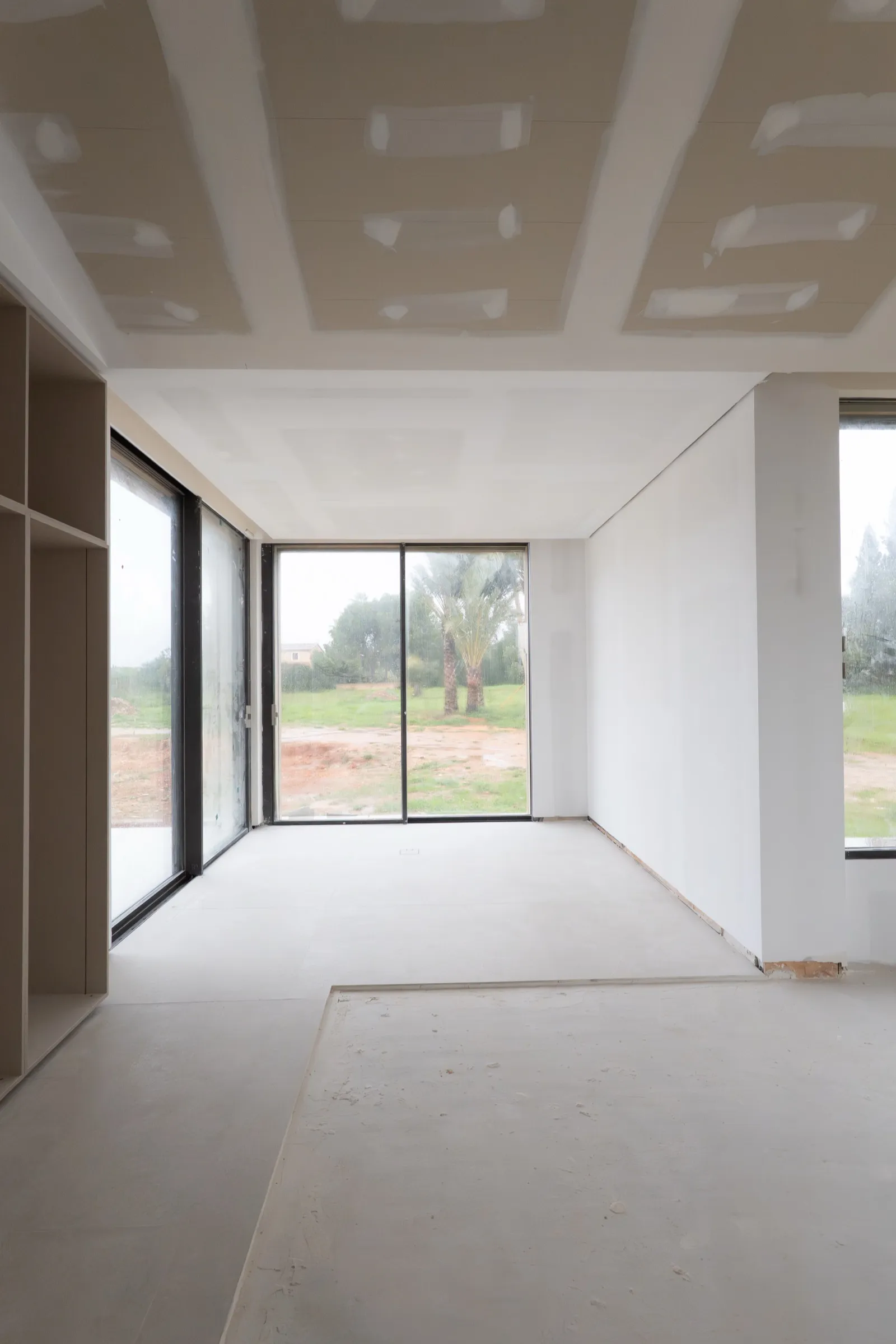
On speed, drywall wins decisively: a partition is installed in a single day and is ready to paint, while brick needs 10 to 20 days from start to finish, including drying and plastering. Rubble is minimal against the high volume of brick debris, and gypsum dust (coarser and heavier) is contained with plastic sheets, unlike cement dust which gets into everything.
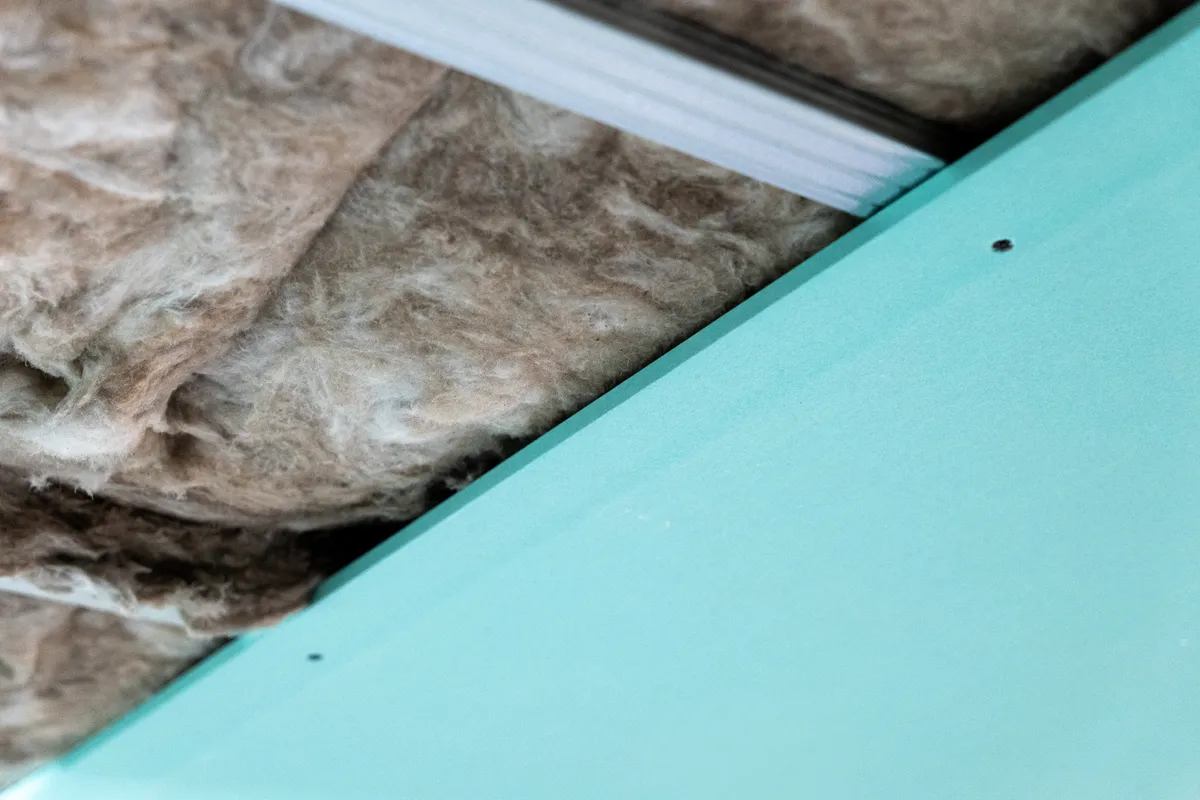
On weight, the difference is decisive for limited slabs: 25-35 kg/m² for drywall against 100-150 kg/m² for brick. Baseline acoustic insulation is similar in both systems, but with drywall it is trivial to fit Isover Arena 40 mm or Rockwool mineral wool between CW48 studs; on a finished brick partition it is difficult and expensive. Same for thermal insulation: fitting it into drywall is straightforward (compliant with CTE DB-HE §3, Mallorca climate zone B3), into brick requires an added wall lining.
On price, an installed drywall partition sits at €45-52/m², against €55-70/m² for plastered brick. Drywall also offers greater design flexibility (curves, levels, arches), is fully reversible without demolition, and makes it far easier to integrate electrical and plumbing services. Brick stands out on direct load-bearing, resistance to continuous moisture and is the mandatory choice for external use.
Data aligned with the Mallorca market 2025-2026. For a tailored estimate, see the drywall price table for Mallorca.
Where Drywall Clearly Wins
Speed of execution
A 15 m² drywall partition is installed in 1 day and is primed and ready to paint the next day. An equivalent brick partition needs 1 day laying, 2-3 days mortar drying, 1 day two-sided plastering and 3-5 days plaster drying before paint depending on ambient humidity. We are talking 5-10 days minimum.
In Mallorca, where holiday-rental renovations have very tight windows between seasons (usually October to April), this timescale difference is decisive to meet season opening.
Price on interior renovations
Drywall is cheaper overall. Not only because of comparable or slightly lower material cost, but because of labour: a drywall installer delivers 25-35 m² of partition per shift; a bricklayer lays 15-20 m². That feeds directly into the final price per installed m².
Drywall also generates no meaningful rubble. In Mallorca, skip management adds €200-600 to a typical renovation depending on volume and site location.
Clean works
The cement dust from traditional construction gets into furniture, clothes in wardrobes, appliances and the inside of drawers. It is practically impossible to contain with plastic in occupied homes or premises with stock.
Drywall is cut with a utility knife (straight cuts) or a jigsaw (cut-outs). The dust is gypsum, coarser and heavier than cement dust, much easier to clean up and contain. In works on operating premises, this difference is decisive.
Versatility and design
Drywall allows shapes that are impossible or prohibitively expensive in brick: multi-level ceilings, arches, vaults, decorative niches, integrated mouldings, curved walls. The metal framing can be bent at radii from 60 cm with flexible studs.
To see the full dry-build catalogue, see drywall installation in Mallorca.
Integration of insulation
Fitting Isover Arena 40 mm or Rockwool mineral wool, stone wool or polyurethane foam between CW48 studs is part of the standard process: placed before closing the second face. Added material cost is €6/m² and the result in acoustic insulation (up to +12 dB, within the CTE DB-HR §2.1 threshold: 50 dB DnT,A between dwellings) and thermal insulation is far superior to uninsulated brick.
Achieving the same level in an existing brick partition forces an added wall lining (€35/m² extra) that complicates the works and pushes total cost up.
When a Brick Partition Wall IS the Right Choice
Being honest about drywall's limitations is part of the service. There are three situations where a brick partition wall (4-5 cm single hollow brick, 7-9 cm double hollow brick or 11.5 cm perforated brick) or block is the right solution, even the only technically valid one: heavy direct loads, capillary moisture and façades.
Heavy direct loads on the wall
For full kitchens with loaded units, shelves packed with books or heavy equipment, brick offers greater direct anchoring capacity. Drywall takes loads with the right fixings (up to 50 kg per metal anchor and 80-120 kg per linear metre with timber blocking in the frame), but has a limit brick does not.
In practice, 90% of items people hang on domestic walls are within drywall capacity with proper fixings.
Capillary moisture and continuous exposure
Standard type A boards are sensitive to sustained moisture. Moisture-resistant type H boards (Glasroc H, Knauf Aquapanel) withstand occasional moisture in bathrooms and kitchens, but if the wall is permanently exposed to moisture or continuous water splashes, brick is more robust.
In shower areas it is common to combine moisture-resistant drywall as lining + tiles as finishing and waterproofing. The issue appears with capillary moisture at the base (old building walls in contact with ground), where brick also struggles but does not deteriorate structurally.
External walls and façades
Standard drywall is not designed for external use. Interior façade linings exist, but the outside face needs weather-rated materials. Your home's façade is not drywall territory.
When Should You Choose Drywall?
Pick drywall in the vast majority of interior renovation jobs. It is the best option when:
- You need to reshape interior spaces (rooms, partitions, wardrobes, toilets).
- You want to improve acoustic insulation between rooms or against neighbours.
- You are renewing degraded ceilings or hiding services.
- You have a tight deadline that does not allow weeks of work.
- You live in an old building with limited slabs (drywall saves up to 125 kg/m² against brick).
- You run commercial premises, restaurants or offices that cannot stay closed long.
When Should You Choose Brick or Block?
Pick brick or block when:
- The wall bears structural loads (rare in interior renovations).
- There is chronic capillary moisture or continuous water exposure with no waterproofing option.
- It is an external wall or in direct contact with the outside.
- Regulations require uniformity with high-mass neighbouring walls.
Typological Comparison: 100-130 m² Commercial Premises for coworking
Frequent pattern in Manacor, Inca, Palma and Calvià: 100-130 m² commercial premises converted into coworking with 3-5 offices, meeting room and common area. Indicative comparison between both systems.
Brick option (market ranges):
- Total cost: €16,000-21,000 (materials, labour, plastering, debris management).
- Timescale: 5-7 weeks (including drying, plastering and cleaning).
- Debris: 2 skips of 6 m³.
- Closure: 5-7 full weeks.
Drywall option (market ranges):
- Total cost: €9,500-12,500 (CW48 framing, double 12.5 mm BA13 board to UNE-EN 520, 50 mm Isover Arena acoustic mineral wool between offices, false ceiling with integrated LED, EI-30 sectorisation in server zone using type F board per CTE DB-SI §3.2, finish ready to paint).
- Timescale: 2-3 weeks (including electrician coordination).
- Debris: 1 bag of offcuts.
- Closure: 2-3 weeks.
Common balance:
- Cost saving: 35-40% less with drywall.
- Time saving: 3-4 weeks less of closure, avoiding additional revenue loss.
- Drywall partitions can fit 50 mm acoustic mineral wool, delivering +8-12 dB of insulation between offices over uninsulated double hollow brick.
In most cases, the premises open on time with a flawless finish. For similar projects, see the interior renovations with drywall in Mallorca guide.
The Final Call: A Practical Criterion
If the wall is internal, not exposed to permanent moisture and has no structural function, drywall is almost always the best technical and economical option for renovation in Mallorca.
Brick has a cultural weight in Spanish construction that sometimes leads to picking it out of habit or the sense that "it is more solid". In structural new-build, that perception holds. In interior renovation of homes or premises, properly executed drywall (UNE-EN 520 board, UNE-EN 14195 framing, correct joint treatment) has nothing to envy brick on perceived solidity and beats it on almost every other criterion.
To see how much your project might cost with drywall and understand real prices in 2026, read the drywall pricing in Mallorca 2026 guide.
If you are clear drywall is your solution, check the interior drywall renovations guide or directly request your no-obligation quote. Response within 24 hours.