Noise is one of the most frequent problems in Balearic homes. Traffic on Palma's avenues, nightlife in tourist areas and neighbours in pre-2007 buildings routinely exceed the legal noise immission limits.
The national framework is the Basic Document HR (Protection against Noise) of the Spanish Building Code (Código Técnico de la Edificación), known as the CTE-DB-HR. It sets DnT,A ≥ 50 dB between dwellings, 55 dB against activity premises and L'nT,w ≤ 65 dB for impact noise. The Balearics add the Noise Pollution Act (Ley 1/2007) and Decret 8/2012 (35 dBA at night inside bedrooms).
If you are after a direct solution, see acoustic insulation in Mallorca.
What the CTE-DB-HR Is
The CTE-DB-HR came into force in October 2007, replacing the old NBE-CA-88 (1988). Before 2007, single hollow-brick party walls barely reached 35-40 dB of insulation, when the threshold for reasonable coexistence is 50 dB.
Goals of the DB-HR
- Limit the transmission of airborne noise between rooms (conversations, music, TV).
- Limit the transmission of impact noise through floor slabs (footsteps, knocks).
- Limit noise from the building's services (lifts, pipework, air conditioning).
Laboratory values (Rw) vs on-site values (DnT,A)
The CTE requires on-site values, not laboratory ones. Rw (per UNE-EN ISO 10140) is measured under ideal conditions; DnT,A (per UNE-EN ISO 16283-1) reflects the finished building with flanking transmissions, acoustic bridges, socket boxes and workmanship defects.
A Knauf W112 system rated 55 dB Rw in the lab can end up at 48 dB DnT,A on site if the workmanship is poor.
Table 2.1 of the CTE-DB-HR §2.1: Minimum Values
DB-HR §2.1 "Insulation limit values" — Airborne noise insulation (DnT,A, dB):
- Between a dwelling unit and any other habitable room: ≥ 50 dB.
- Between a dwelling unit and a plant/services room: ≥ 55 dB.
- Between a dwelling unit and an activity room (bar, restaurant, shop): ≥ 55 dB.
Impact noise (L'nT,w, dB) — DB-HR §2.1:
- Maximum in a protected room (bedroom, living room): ≤ 65 dB.
Noise from building services:
- LAeq ≤ 30 dBA (continuous noise: boiler, extractor).
- LAmax ≤ 33 dBA (intermittent noise: lift, cistern).
Reverberation time (RT60, DB-HR §2.2 "Reverberation time limit values"):
- Classrooms and lecture rooms V ≤ 350 m³ (unoccupied, unfurnished): RT60 ≤ 0.7 s.
- Restaurants and dining rooms V > 350 m³: RT60 ≤ 0.9 s.
- Common areas adjoining dwellings (stairwells, lobbies): equivalent sound absorption area A ≥ 0.2 m² per m³ of volume.
Balearic-Specific Regulations
Balearic Noise Pollution Act (Ley 1/2007)
The regional framework classifies acoustic zones and sets outdoor immission limits:
- Residential zone: 55 dBA daytime, 45 dBA at night.
- Healthcare/education zone: 50 dBA daytime, 40 dBA at night.
- Industrial zone: 70 dBA daytime, 60 dBA at night.
Decret 8/2012: 35 dBA at night indoors
Decret 8/2012 sets the maximum indoor immission limit in bedrooms at 35 dBA during night hours (22:00-08:00). A critical threshold for hotels, holiday apartments (ETV) and homes adjoining nightlife.
Palma's noise by-law
It regulates hospitality venues, nightclubs and concert halls. Relevant in Santa Catalina, La Lonja, El Terreno and the Historic Centre. It demands additional insulation from activity-licence holders.
Other municipalities
Calvià (Magaluf, Palmanova), Llucmajor (S'Arenal), Alcúdia (the Port) and Manacor have their own by-laws, stricter in areas of tourist concentration.
Pre-2007 Buildings: The Structural Problem
The CTE-HR does not apply retroactively. Mallorca's housing stock has a high share of buildings predating October 2007:
- 1950s-60s: load-bearing walls and joist slabs with no acoustic criteria. Actual insulation 35-40 dB.
- 1960s-80s: single hollow-brick party walls (4-5 cm), joist-and-block floor slabs. 38-43 dB.
- 1980s to 2007: double hollow brick (7-9 cm) or perforated brick, sometimes with an air cavity. 42-47 dB.
All below the CTE minimum of 50 dB. For specific solutions, see acoustic insulation in Palma's older buildings.
Post-2007 buildings
Required to comply with the CTE-HR. Many developers in Mallorca adopt Knauf, Placo and Lafarge systems for interior divisions because they reach the required values with less weight and better traceability.
Partial renovations
Not mandatory, but the CTE values are the minimum technical benchmark. Investing once to CTE standard avoids redoing the works.
Drywall Solutions That Meet and Exceed the CTE-HR
The mass-spring-mass principle
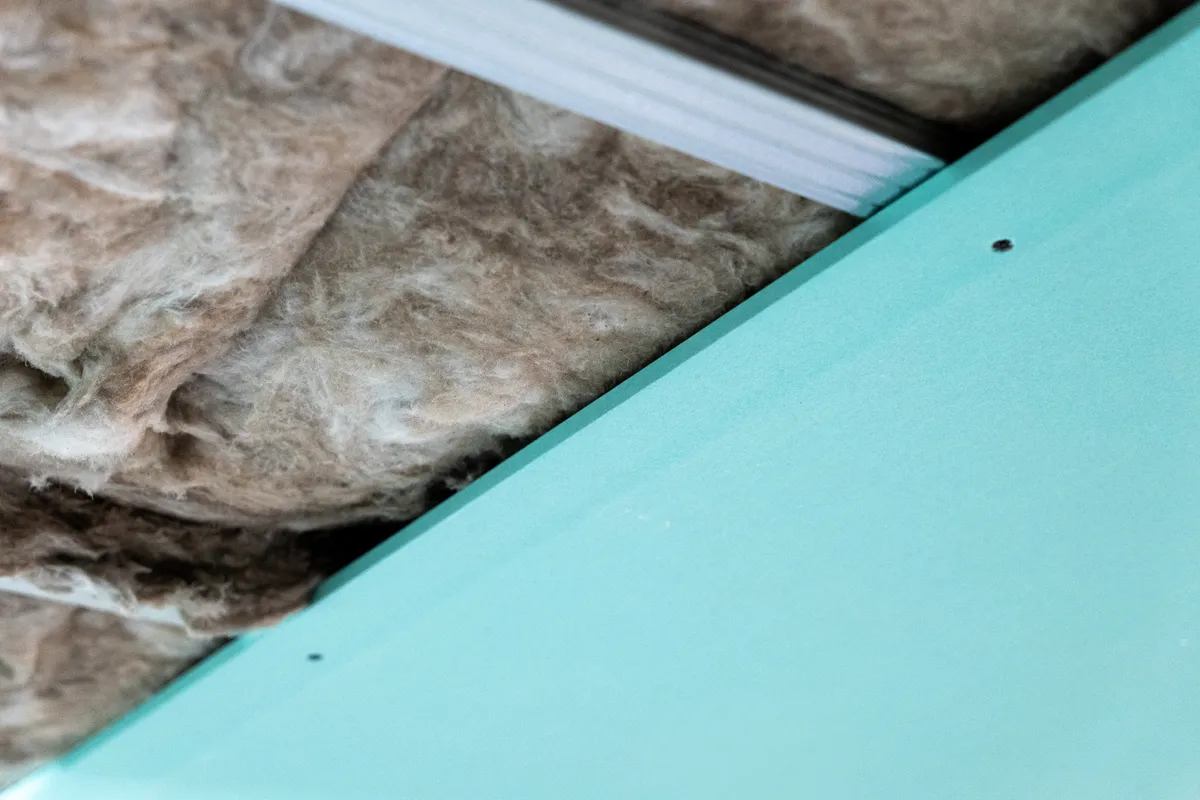
Drywall's acoustic performance rests on the mass-spring-mass principle. The Knauf/Placo/Lafarge boards act as masses; the mineral wool in the cavity works as an absorbing spring. The discontinuity hinders vibration transmission.
A Knauf W112 partition (double board + 60 kg/m³ wool, 50-60 kg/m²) reaches 55-60 dB Rw. An 11.5 cm perforated-brick wall (150-180 kg/m²) reaches 45-48 dB. More insulation with three times less weight.
Systems by performance requirement
DnT,A ≥ 50 dB (DB-HR §2.1, separation between dwellings): self-supporting lining on CW70 (UNE-EN 14195) 70 mm framing, Knauf KGT/KGN perimeter band, Isover Arena or Rockwool Confortpan mineral wool at 60 kg/m³ × 60 mm and double Placo BA13 (UNE-EN 520) 12.5 mm board with staggered joints (Knauf W625 or Placo Prégymétal). 50-53 dB on site. Cost €10-15/m² over an existing wall.
DnT,A ≥ 55 dB (dwelling-premises separation): double independent frame (no contact), 80 mm mineral wool and double board with a viscoelastic membrane (Placo Phonique or Knauf Silentboard). 55-60 dB on site. €15-22/m².
L'nT,w ≤ 65 dB (impact noise): false ceiling with anti-vibration suspension (Sylomer silent blocks), 80 mm mineral wool and double board. Meets the limit combined with the existing floor slab. €15-20/m².
See drywall installation in Mallorca for system details.
Critical build details
- EPDM anti-vibration bands at every contact point between the frame and walls, floor and ceiling.
- Perimeter joint sealing with flexible acoustic sealant.
- Acoustic socket boxes or boxes sealed with intumescent putty (one badly sealed socket loses 5-8 dB).
- Service penetrations sealed with elastic materials.
Typological Case: 1965-1980 Buildings in Palma's Ensanche
Typical starting point
Buildings from 1965-1980 with 4-5 cm single hollow-brick party walls under gypsum plaster. Typical measured insulation: 35-40 dBA (vs CTE 50 dB). Prestressed joist-and-block floor slab with no absorbent layer: impact noise 74-80 dB (vs CTE 65 dB).
Typological solution
- Party walls: decoupled self-supporting lining, 70 mm frame set 10 mm off the wall on EPDM bands, 60 kg/m³ × 60 mm mineral wool, double 12.5 mm board with staggered joints. Recessed acoustic socket boxes.
- Ceiling: false ceiling on Sylomer anti-vibration suspension, 80 mm mineral wool and double board. Light fittings in sealed boxes.
Typical on-site results (UNE-EN ISO 16283-1 and 16283-2)
- Airborne noise through party walls: 50-54 dBA (improvement +13-16 dB, meets CTE ≥ 50 dB).
- Impact noise: 60-64 dB (improvement -14 to -18 dB, meets CTE ≤ 65 dB).
Indicative investment
- Total cost for an average flat (~85 m² treated: 28 m² party walls + 42 m² false ceiling): €7,000-8,500 (VAT not included).
- Timescale: 6-8 working days.
On-Site Acoustic Testing
ENAC-accredited laboratories test per:
- UNE-EN ISO 16283-1: airborne noise.
- UNE-EN ISO 16283-2: impact noise.
- UNE-EN ISO 16283-3: façade.
When they are mandatory in Mallorca
- Sampling in new buildings with more than 10 dwellings.
- Hotels and holiday apartments with an activity licence (Consell de Mallorca).
- Hospitality venues facing neighbour complaints.
- Court claims between neighbours (Ley 1/2007).
Cost
€300-600 per measuring point. Typical dwelling: 2-4 points (party wall, floor slab, façade) = €600-2,000 with a technical report.
Practical Recommendations
- Identify the main transmission path before spending: wall, floor slab, sockets or façade.
- Prioritise decoupled solutions: a glued lining gains 3-5 dB; a decoupled one on bands gains 10-15 dB. Added cost: €3-5/m².
- Do not skimp on high-density mineral wool (60 kg/m³ vs 20 kg/m³). Price difference €2-4/m², performance 30-40% higher. See soundproofing prices in Mallorca.
- Demand anti-vibration bands and acoustic sealing: they make the difference between 45 and 52 dB with the same system.
- Intervene comprehensively: noise takes the easiest path. Insulating only the wall redirects the noise to the floor slab or the sockets.
Next Step
We assess the acoustic insulation of your home in Mallorca on site, free of charge. We analyse the transmission paths and deliver a fixed quote with the solution that meets the Spanish CTE-DB-HR.
See acoustic insulation services in Mallorca or request your free assessment. Direct line 627 829 723.