Neighbour noise is the number one insulation enquiry we receive in Mallorca: conversations you can follow word by word, televisions at eleven at night, rattling roller shutters. The good news: a party wall can be soundproofed in 1-2 days with a decoupled drywall lining, and the improvement is 12 to 17 dB — perceived as half the original noise or less.
The bad news: most solutions sold as "soundproofing" (adhesive panels, anti-noise paints, cork) do not work against neighbour noise. In this guide we explain the system that does work, step by step, with the materials and the mistakes that ruin the result.
Soundproofing a wall against noise: mass, spring and decoupling
A 7-9 cm hollow-brick party wall — the standard in Mallorcan buildings from 1960 to 1985 — provides 33-38 dB of insulation. The current Spanish CTE DB-HR requires 50 dB between dwellings: the deficit is 12-17 dB, exactly what a good lining delivers.
Blocking airborne noise takes three things, all three at once:
- Mass: heavy material that resists vibrating (plasterboard, ideally doubled).
- Spring: a fibrous material that absorbs energy inside the cavity (rock wool or mineral wool, never an empty air gap).
- Decoupling: the new wall must not rigidly touch the original one, so the vibration has no direct path.
Adhesive panels fail because they only add a few grams of mass with no spring and no decoupling: 2-5 dB improvement at best. A decoupled lining satisfies all three principles.
Materials for the acoustic lining
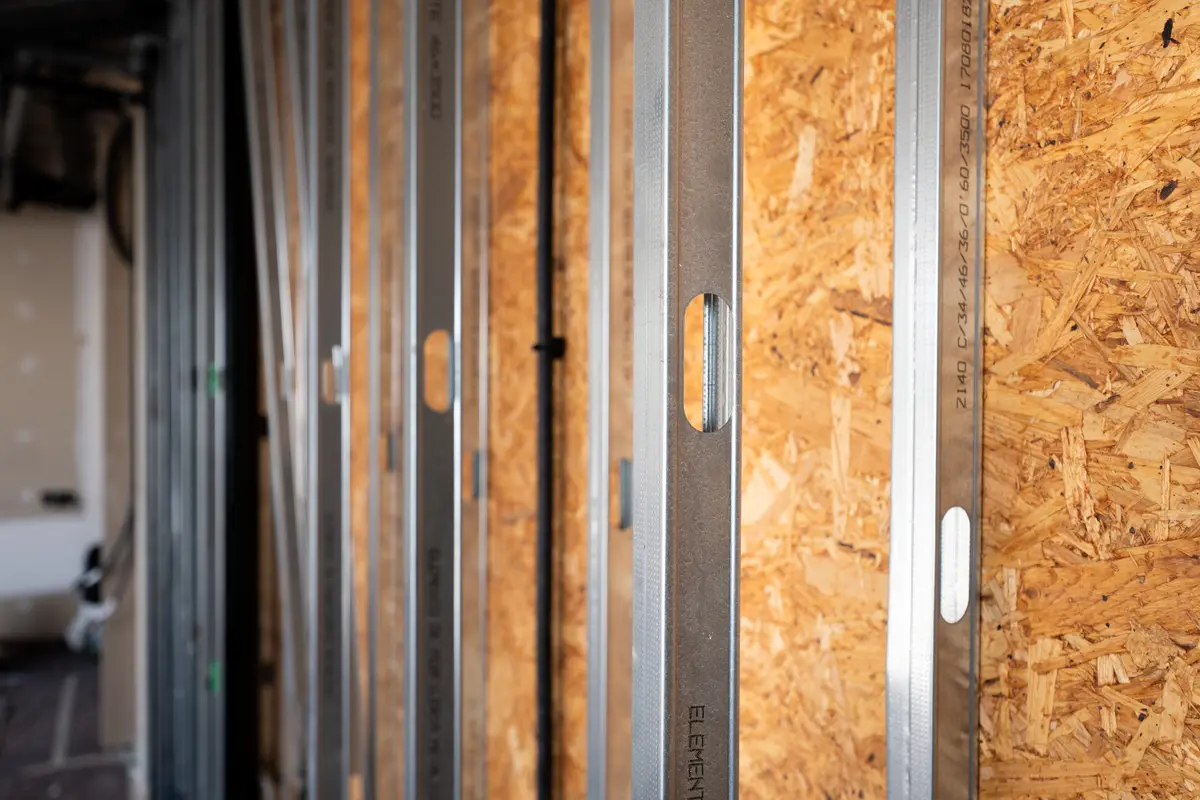
- 48 or 70 mm metal framing (Placo or Knauf channels and studs): a self-supporting structure that is NOT anchored to the wall being soundproofed, only to floor, ceiling and side walls.
- Self-adhesive elastomeric band under all perimeter profiles: it cuts the acoustic bridge with the slab.
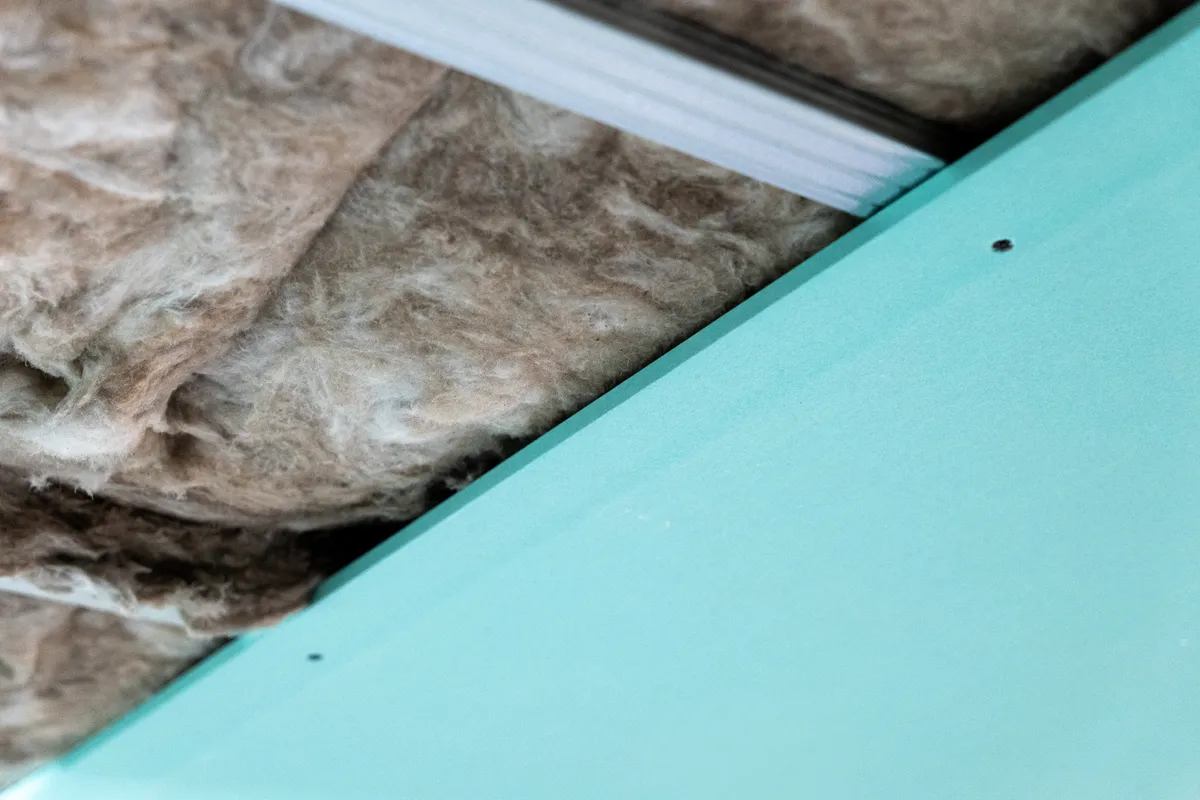
- 48-70 mm rock wool at 40-70 kg/m³ (Rockwool 226 or Isover Arena): the spring. Density matters — lightweight 15 kg/m³ thermal wool performs several dB worse.
- 12.5 or 15 mm plasterboard, ideally a double layer with staggered joints. For maximum performance, high-density acoustic board (Placo Phonique, Knauf Diamant): +3 dB over standard board.
- Acoustic sealant for the perimeter and socket boxes.
Step by step: how it is installed
- Diagnosis: confirm the noise comes through the wall and not through flanking paths (ceiling, floor, shutters, downpipes). Soundproofing the wrong wall is the most expensive mistake.
- Setting out: mark the lining line with a laser, 10 mm away from the original wall. The air gap adds insulation.
- Band and channels: stick the elastomeric band under the floor and ceiling channels, screw them to the slab — never to the party wall.
- Studs: place vertical studs every 40 cm (better than 60 cm for acoustics), without touching the original wall.
- Rock wool: fill the whole cavity without gaps and without compressing the material. Every gap is a noise path.
- Boards: screw on the first layer, seal the perimeter with acoustic sealant, and fit the second layer with staggered joints.
- Finishing: tape and fill the joints, seal the junctions with ceiling and floor, and relocate sockets into sealed airtight boxes (a through-wall socket can cost 3-4 dB).
With the standard Q3 finish the wall is ready to paint within 24-48 hours.
The 4 mistakes that ruin a soundproofing job
- Anchoring the lining to the neighbour's wall: every screw into the party wall is an acoustic bridge that transmits vibration. It is the number one error in non-professional installations.
- Leaving the cavity empty: the air inside the cavity resonates like a guitar body. Without wool, the lining can even amplify low frequencies.
- Forgetting the perimeter: noise goes around the board through the junctions with ceiling, floor and walls if there is no band and sealing. The real insulation is set by the weakest point.
- Ignoring flanking paths: if noise also comes through the ceiling (footsteps), the wall alone is not enough; consider a ceiling soundproofing service with acoustic hangers.
Soundproofing a wall without building work: what works and what does not
It is the question we hear most often after price: "can I soundproof the wall without building work?". The honest answer: without any work, very little; with half a day of minimal dry construction, somewhat more; with a decoupled lining, a lot. Let's break it down.
High-density membranes like Tecsound: what they achieve on their own
High-density viscoelastic membranes (Tecsound by Soprema is the best known) are flexible sheets of concentrated mass: the SY 70 model weighs 7 kg/m² at only 3.7 mm thick, and the SY 100, 10 kg/m² at 5.3 mm (Soprema data sheet).
The problem is physics. A 7-9 cm hollow-brick party wall weighs 80-100 kg/m²: gluing a 7 kg/m² membrane onto it increases its mass by less than 10%. And the mass law says that gaining 4-6 dB of insulation requires doubling the wall's mass. The real result of a membrane glued to the wall on its own: 1-3 dB of improvement, below what the ear perceives as a clear change. Anyone selling it as "soundproofing without building work" is selling the product, not the result.
Where the membrane does perform is inside a system: bonded to the board of a lining, or between two boards, it acts as a damping membrane that curbs the assembly's resonance and adds 3-5 dB to the complete system.
Direct lining: the real middle-ground option
If you cannot lose 8 cm of room, there is the direct lining: 12.5 mm plasterboard with a high-density membrane bonded to it, glued to the wall with adhesive compound, with no framing. It loses only 4-5 cm and improves 6-9 dB for €35-50/m² installed (indicative price). Its limit: there is no real decoupling — the board stays in contact with the wall through the adhesive — so it delivers roughly half of what a decoupled lining does. It makes sense in small rooms with moderate noise; against a neighbour you can hear word by word, it falls short.
What simply does not work
Adhesive foam panels, cork, "anti-noise" paints and acoustic curtains improve 0-5 dB at best: they condition the reverberation inside your own room, but they do not block the noise coming through the wall. Against neighbour noise you need mass, spring and decoupling — and that, today, means a lining.
Before spending a single euro, confirm where the noise comes in. If what you hear is footsteps, dragged furniture or knocks from the neighbour above, the noise enters through the slab and treating the wall is throwing money away: the solution is soundproofing the ceiling in Mallorca, with acoustic hangers and a typical improvement of 15-20 dB. During the free technical visit we measure it and tell you before quoting.
Indicative prices in Mallorca 2026
| System | Improvement | Installed price | Thickness lost |
|---|---|---|---|
| High-density membrane alone (Tecsound SY 70 type, glued to the wall) | 1-3 dB | €15-25/m² | 0.4 cm |
| Direct lining (board + membrane, no framing) | 6-9 dB | €35-50/m² | 4-5 cm |
| Decoupled lining + rock wool + standard double board | 12-15 dB | €58-75/m² | 6-8 cm |
| Same with high-density acoustic board (Phonique/Diamant) | 15-20 dB | €75-95/m² | 7-9 cm |
| Typical 10 m² party wall (decoupled system) | — | €600-950 | — |
VAT not included (10% for renovations of homes over 2 years old). If you are looking for quotes broken down by whole-flat area, see the table in our guide to the price of soundproofing a flat in Mallorca.
Do it yourself or call a professional?
An experienced DIYer can build a simple lining, but acoustics is unforgiving: an invisible acoustic bridge or a poorly sealed perimeter eats half the improvement, and you only find out once the work is finished and painted. Our acoustic insulation in Mallorca team installs the complete system with result testing on projects where the CTE applies, and we provide a written guarantee.
If the soundproofing is part of a larger redistribution, also look at our acoustic double-board drywall partitions, which reach 52-55 dB between rooms, and the updated 2026 drywall price table.
Neighbour noise in your Mallorca flat? Free technical visit within 24-48 h anywhere on the island: we measure, tell you where the noise really comes in and give you a fixed written quote. Call us on 627 829 723 or request a quote online.